
In today’s hyper-connected world, mobile applications have become an essential part of how we shop, work, learn, communicate, and stay entertained. Whether you’re a startup planning your first MVP or an established business looking to expand your digital presence, deciding whether to develop your app for iOS, Android, or both is one of the earliest — and most critical — decisions you’ll face. The decision between iOS and Android app development isn’t as simple as it may appear. The Role of AI in Mobile App Development plays a significant part in this decision-making process. While both platforms dominate the global smartphone market, they differ in terms of market share, development ecosystems, monetization potential, security standards, user demographics, and user experiences. These differences directly influence your app’s reach, performance, revenue potential, and long-term success.
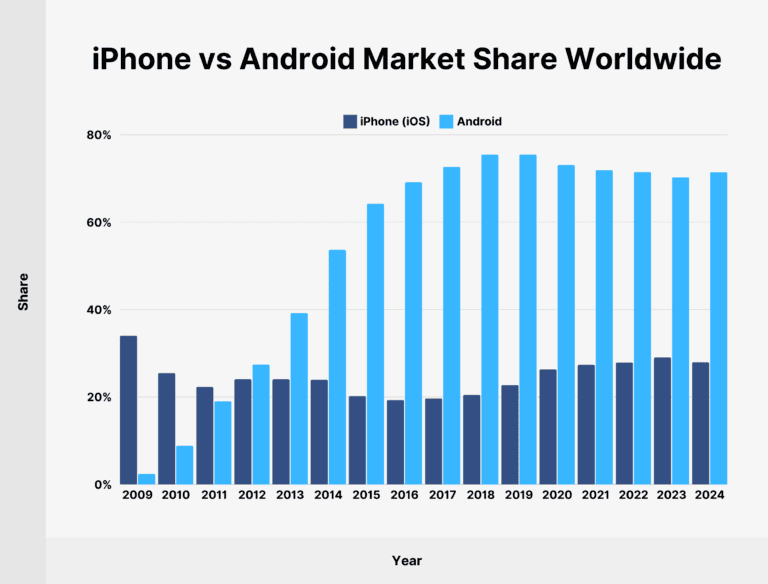
As of 2024, Android holds around 70% of the global smartphone market share, while iOS claims about 28%. But this doesn’t necessarily mean Android is always the better choice — it largely depends on your target audience, business objectives, project budget, and timeline. For example, if your primary market is North America or Western Europe, iOS might be your ideal starting point since Apple devices maintain a stronger presence in these regions. On the other hand, if you’re targeting emerging markets like India, Brazil, or Southeast Asia, Android’s widespread adoption could give your app a significant advantage.
Moreover, app monetization models differ notably between iOS and Android. Statistically, iOS users tend to spend more on in-app purchases, subscriptions, and premium app downloads compared to Android users. This can make a substantial difference in your business model, especially if you’re planning a freemium or subscription-based app.
From a development perspective, choosing between these platforms involves weighing factors like development costs, tools, coding languages, testing processes, device fragmentation, and app store approval requirements. iOS development, primarily done using Swift or Objective-C, benefits from a relatively unified device ecosystem and streamlined testing. Android, developed with Java or Kotlin, faces greater challenges with its broader range of devices, screen sizes, and hardware specifications.
Security and privacy standards also vary between the two. Apple is well-known for its stringent privacy controls and app store review policies, whereas Android offers more flexibility but requires developers to take extra care in securing apps against threats and vulnerabilities.
Your decision will also affect post-launch app maintenance and updates. iOS users typically adopt new OS updates much faster than Android users, simplifying the process of app compatibility updates. Android’s diverse device ecosystem, while advantageous for reach, adds complexity to maintaining a consistent and bug-free user experience across various devices.
In this comprehensive guide, we’ll help you navigate the iOS vs. Android dilemma by breaking down key differences, benefits, limitations, and use cases for both platforms. By the end of this article, you’ll have a clear understanding of which platform aligns best with your business goals and how you can strategically plan your mobile app development journey.
Market Share & User Demographics: Where Are Your Users?
When planning your mobile app development, understanding where your potential users are and which platforms they use is a strategic decision that directly affects your product’s marketability, reach, and revenue. While both iOS and Android dominate the global market, their market share, audience profiles, and user behaviors differ significantly across regions and demographics.
Globally, Android commands a market share of around 70%, with iOS holding about 28%. However, these numbers vary greatly depending on location, income levels, and consumer preferences. For instance, North America and Western Europe are predominantly iPhone markets, while Asia, Africa, and South America lean heavily toward Android due to its affordability and device variety.
Moreover, platform-specific user demographics reveal that iOS users generally belong to higher income groups, spend more on apps, and adopt new technology faster than their Android counterparts. Meanwhile, Android’s strength lies in its sheer user base volume, affordability, and presence in emerging markets.
Recognizing these variations is vital to deciding which platform aligns best with your business goals, revenue model, and target market.
Global Mobile OS Market Share: Android vs. iOS
Globally, the mobile operating system market is primarily divided between Android and iOS. As of 2024, Android holds a commanding lead with nearly 70% of global smartphone users, while iOS accounts for approximately 28%. The remaining share belongs to other niche platforms like HarmonyOS or KaiOS. However, looking solely at these numbers doesn’t present the full picture.
While Android dominates in terms of raw user numbers, primarily because of its presence in price-sensitive markets like India, Southeast Asia, South America, and Africa, iOS holds significant influence in premium markets such as the United States, Canada, Western Europe, Australia, and Japan. In fact, in regions like the U.S., iOS has overtaken Android with about 56% market share. This distinction is crucial for businesses. If your app targets a global audience seeking reach and volume, Android might be your best bet. But if your core users are in high-income, developed countries, iOS should be prioritized for its purchasing power and brand loyalty.
How Geography Influences OS Popularity
Geography plays a massive role in platform choice. In North America, Western Europe, Australia, and Japan, iOS leads comfortably, with Apple devices dominating consumer preferences due to their premium image, superior security, and consistent user experience. In the U.S. alone, over 56% of smartphones are iPhones. Conversely, Android thrives in emerging markets like India, Brazil, Southeast Asia, the Middle East, and Africa.
Affordable device options from brands like Samsung, Xiaomi, Vivo, and Realme make Android highly accessible in price-sensitive markets. Its open-source flexibility also makes it popular among developers and OEMs. For businesses and app owners, this means your geographical target audience should heavily influence your platform choice. A fintech app aimed at U.S. users may benefit from iOS exclusivity initially, while an eCommerce or healthcare mobile app targeting India would fare better on Android. This decision directly impacts development strategy, marketing plans, and user acquisition costs.
Who Are the Users and How Do They Spend?
User demographics for iOS and Android show marked differences. iOS users generally belong to higher income brackets, are younger, urban-centric, and highly tech-savvy. They also display a higher propensity to spend on apps, subscriptions, and in-app purchases. Studies have consistently shown that iOS users outspend Android users by a significant margin, especially in categories like gaming, streaming, and lifestyle apps.
In contrast, Android users cover a broader demographic spectrum, ranging from high-end device owners to entry-level smartphone users. While the average spending per Android user is lower, Android’s global reach and sheer volume of users balance the scales, making it ideal for apps leveraging advertising-based or freemium models. If your app monetization relies on subscriptions, in-app purchases, or premium services, iOS might offer better ROI. For apps where scale, engagement, and ad revenue matter more than individual user spend, Android’s massive global audience is unmatched.
Uniform iOS vs. Diverse Android
One of the biggest differences between the two platforms is device fragmentation. Apple’s iOS ecosystem is highly unified, with a limited number of devices and consistently fast adoption of new iOS updates. Over 70% of iPhones are typically updated to the latest iOS version within months of release. This simplifies app development, testing, and maintenance for businesses. Android, however, operates on thousands of devices across various manufacturers, screen sizes, and hardware configurations.
Android OS update adoption is much slower and fragmented. Only 20–30% of Android users are on the latest OS version at any given time. This fragmentation can increase development complexity and post-launch maintenance costs for Android apps. Testing across multiple devices becomes essential to ensure a seamless user experience, especially for graphic-heavy or performance-centric applications. Businesses need to factor this into their time-to-market and QA resource planning.
Development Cost & Time: Budget and Timeline Considerations
Choosing the right platform for your mobile app isn’t only about audience reach and device preferences — it’s a business decision that directly affects your development budget, project timelines, and ongoing maintenance costs. Both iOS and Android development follow distinct processes, tools, and testing standards, resulting in cost and time differences businesses must account for before starting a project.

Several factors contribute to this, including the complexity of the app, number of supported devices, UI/UX requirements, third-party integrations, and QA cycles. Although both iOS and Android apps are built on similar foundations (using languages like Swift for iOS and Kotlin for Android), the operational processes vary. Understanding these nuances will help your business make a more cost-effective, strategic decision while maximizing ROI and time-to-market efficiency.
Comparative Costs: iOS vs. Android Development
The cost of developing a mobile app depends on multiple variables: app type, feature set, development hours, and platform-specific complexities. Generally, iOS apps tend to be marginally cheaper and faster to develop for mid-sized applications because Apple devices are fewer in number and relatively uniform in screen sizes, hardware configurations, and OS versions.
In contrast, Android app development involves testing across a vast range of devices and OS versions, adding to development hours and QA expenses. Custom Android apps for highly diverse markets require extra optimization for different screen sizes and hardware limitations.
On average:
- iOS apps can cost between $25,000 to $150,000
- Android apps range from $30,000 to $180,000
This variance widens for complex apps involving features like real-time chat, payment gateways, AI integration, or AR/VR modules. Businesses should factor in not only initial development costs but also future updates, security patches, and compatibility maintenance while budgeting.
iOS vs. Android: Time-to-Market Insights
Timelines for mobile app projects hinge on scope, features, and platform selection. iOS apps typically take less time to develop due to the controlled Apple ecosystem, limited number of device models, and streamlined app approval process. Most iOS apps can be delivered in 3 to 6 months for medium-complexity projects. Android development often requires additional weeks of device optimization and quality assurance testing, especially for apps targeting global markets where screen resolutions, processor speeds, and OS versions vary widely.
A comparable Android app might take 4 to 8 months to develop and launch. Another factor is the app store review process. Apple’s App Store has stricter approval guidelines, but review times have improved recently. Google Play reviews are faster but demand extensive in-house testing due to the fragmented device ecosystem.
Platform-Specific Design Complexity and UI/UX Costs
The user interface and experience are critical to an app’s success, and both platforms follow distinct design systems. iOS apps are built on Apple’s Human Interface Guidelines (HIG), offering a consistent design philosophy across apps. This makes designing for iOS streamlined, faster, and cost-effective. Android apps, however, use Google’s Material Design principles. While offering greater flexibility and custom UI opportunities, it demands additional design hours for multi-device compatibility. Screen size variations in Android devices necessitate multiple layout adjustments, typography scaling, and UI testing to deliver a consistent user experience.
On average, UI/UX design can constitute 20-30% of total development costs for both platforms, but this rises for Android due to extra device testing. If your brand prioritizes pixel-perfect interfaces or heavily custom UI elements, expect longer design and prototyping cycles on Android. Focusing on UI/UX consistency and investing in experienced platform-specific designers can significantly optimize this phase.
Read Also : How MVP Development Can Accelerate Your Startup’s Growth
App Store Publishing Fees and Policies
Every app must be submitted and approved before appearing in the respective app stores. Apple charges a $99 annual fee for App Store membership, with stricter app review guidelines covering performance, design compliance, and security. While approval times are faster today, Apple maintains rigorous standards. Google Play charges a one-time $25 developer registration fee. The review process is relatively lenient, with apps often going live within 24-48 hours post-submission.
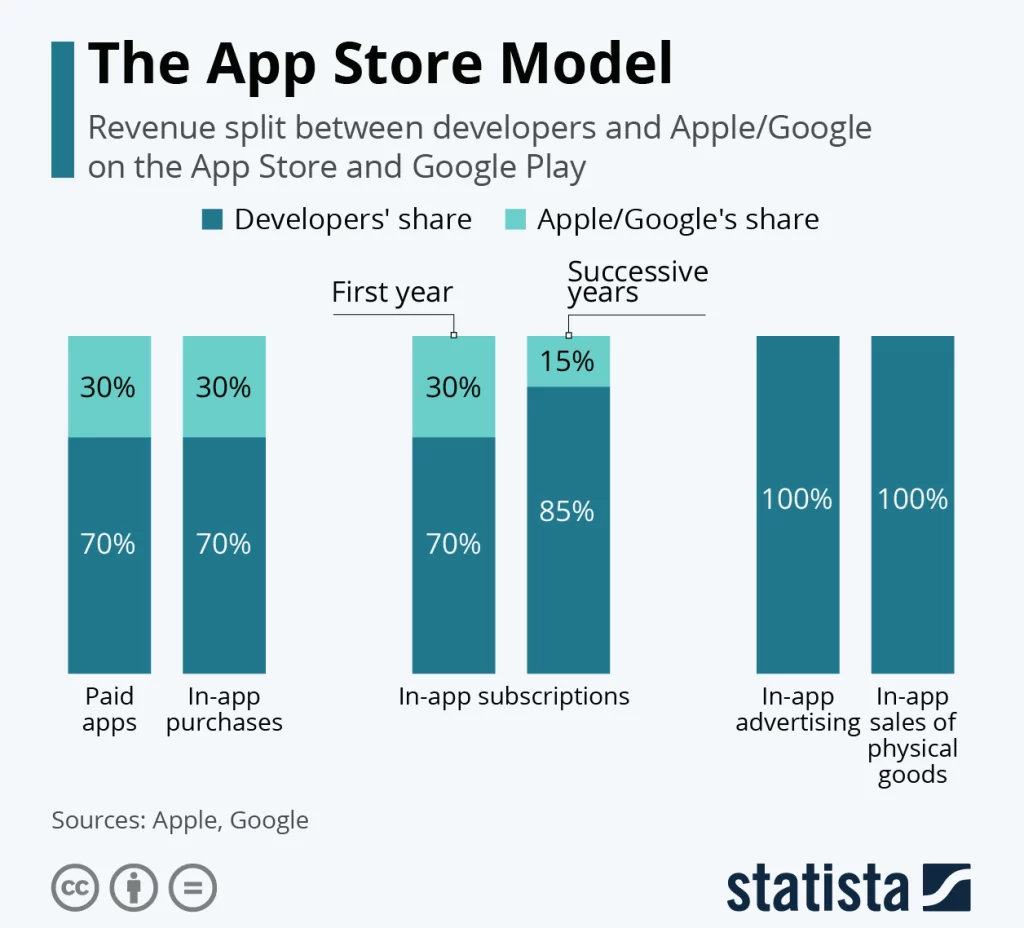
However, developers bear more responsibility for pre-launch QA and security auditing due to the open nature of Android. Both stores charge a 30% commission on in-app purchases and subscriptions, which can drop to 15% for qualifying apps after specific revenue thresholds or under small business programs. Factoring in these costs and approval timelines is crucial for budget planning and go-to-market strategies. iOS’s higher initial costs and tighter reviews can delay launches but offer access to premium-paying audiences.
App Monetization Opportunities: Where’s the Revenue?
Monetizing your mobile app is not an afterthought — it’s a core part of your product strategy and business model. Whether you’re building for iOS or Android, both platforms offer diverse ways to generate consistent, scalable revenue. However, the success of each model often depends on platform user behavior, spending habits, and regional preferences. While iOS users typically spend more on paid apps and in-app purchases, Android’s wider global reach supports ad-driven and freemium models better.
Selecting the right monetization strategy ensures long-term profitability and shapes the app’s design, functionality, and marketing approach from day one. In this section, we’ll explore the most effective monetization opportunities available on both platforms.
Unlock Premium Features and Digital Goods
In-app purchases (IAP) allow users to buy digital content, features, or subscriptions directly within the app. This is one of the most successful monetization models, especially for iOS apps, where user willingness to pay is higher. Popular in gaming, productivity, and wellness apps, IAPs let developers offer a free app experience with optional premium add-ons.
Examples include:
- Unlocking new game levels
- Accessing advanced productivity tools
- Purchasing virtual currency or filters
- Subscribing to premium content or services
On iOS, over 48% of total app revenue comes from in-app purchases, with average transaction values typically higher than Android. Android supports IAP well, but thrives better in markets where freemium apps dominate. Implementing IAP requires a solid UX design to promote paid features without disrupting the core experience. Apps should carefully balance value creation and upselling opportunities to avoid alienating free users while driving conversions.
Recurring Revenue with Premium Subscriptions
Subscription models have seen explosive growth, particularly in fitness, content streaming, productivity, and finance apps. Users pay a recurring fee — monthly, quarterly, or annually — in exchange for premium access or ad-free experiences. On iOS, subscriptions account for a substantial share of app revenue, with App Store policies reducing the revenue cut from 30% to 15% after a year for each subscriber. This makes it a profitable long-term strategy.
For Android, Google Play also supports subscriptions with similar revenue share models but tends to attract more price-sensitive audiences, requiring strategic pricing and trial offers. Key to subscription success:
- Delivering continuous value with updates and exclusive content
- Offering free trials to drive user acquisition
- Clear, transparent pricing models
- Simple cancellation processes
Subscription apps need robust backends to handle user authentication, content delivery, and recurring billing — areas where Cenozic can architect reliable, scalable solutions.
Monetizing with In-App Ads
Advertising remains a reliable monetization method, particularly for Android apps targeting emerging markets, where users are less inclined to pay for apps or in-app purchases. Developers integrate ads from networks like Google AdMob, Meta Audience Network, and Unity Ads to display banners, interstitials, video ads, or rewarded ads.
Rewarded ads, for example, offer in-app benefits (like game currency or extra features) in exchange for watching a video, improving user tolerance toward ads. While iOS also supports in-app advertising, Android’s larger market share and lower user transaction rates make it better suited for ad-driven monetization. Factors to optimize ad monetization:
- Balance between ad frequency and user experience
- Targeted ad placements using analytics
- Rewarded ad incentives to boost engagement
Ad revenue depends on impressions, click-through rates, and geography. A well-planned ad strategy can turn a free app into a consistent profit stream without alienating users.
Read Also : How AI and Machine Learning Are Shaping the Future of the Healthcare Industry
One-Time Purchase for Premium Access
Though declining in popularity, paid apps — where users pay a one-time fee to download the app — still work for niche markets like productivity tools, educational content, or exclusive media applications. iOS historically outperforms Android in paid app purchases, driven by higher average transaction values and a premium device user base.
Developers of high-value or specialized apps often launch exclusively on iOS to capitalize on this behavior. Challenges with this model:
- Requires high perceived value before download
- No recurring revenue unless paired with in-app purchases
- Risk of pricing misalignment with user expectations
Effective strategies include:
- Offering a lite or free trial version
- Leveraging user reviews and feature previews
- Targeting professional or enterprise audiences
Paid apps demand excellent pre-launch marketing and branding to convince users to pay upfront — a challenge Cenozic addresses through targeted app marketing strategies and app store optimization services.
Security & Privacy Considerations: Keeping Your Users Safe
In today’s hyper-connected digital economy, mobile apps are prime targets for cyberattacks, data breaches, and unauthorized access. No matter how engaging your app might be, if it compromises personal data, users will uninstall and leave damaging reviews — or worse, it could lead to legal penalties and reputational damage for your business. Both iOS and Android ecosystems prioritize security and privacy, but they follow different protocols and offer varying degrees of control to developers.

Choosing a platform involves understanding its built-in protections, how much responsibility falls on the developer’s shoulders, and what third-party tools can supplement native security. In this section, we’ll explore the crucial security and privacy factors every startup or business must weigh while developing apps for either platform.
iOS: A Controlled, Closed-Source Environment
Apple’s iOS ecosystem is renowned for its stringent security protocols. The platform’s closed-source architecture and tightly regulated App Store review process drastically reduce the risk of malware-infected apps making it to users’ devices. Key security benefits:
- App sandboxing restricts apps from accessing data outside their environment.
- Mandatory code signing ensures only verified developers publish apps.
- End-to-end encryption for iMessage and FaceTime enhances user privacy.
- App Tracking Transparency (ATT) forces developers to request user consent before tracking data.
For businesses dealing with sensitive data — like healthcare, fintech, or enterprise apps — iOS offers a safer foundation. However, Apple’s tight control can limit certain customizations and increase time-to-market, as every app and update requires manual App Store approval. At Cenozic, we help clients navigate these restrictions while maintaining optimal security practices in line with Apple’s ecosystem.
Read Also : Top Trends in FinTech App Development for Modern Financial Solutions
Android: Flexibility With Added Developer Responsibility
Android’s open-source nature and expansive app distribution options make it the most popular mobile OS globally — but this freedom comes with additional security responsibilities for developers. Google Play Protect offers robust baseline protection by scanning apps for malware, while the Google Play Store mandates adherence to its User Data and Privacy Policy. However, Android apps can also be sideloaded from third-party stores, increasing risk if not properly secured. Security best practices for Android:
- Implement OAuth 2.0 authentication
- Use encrypted data storage for sensitive information
- Secure API integrations and use SSL/TLS for network communication
- Regularly patch vulnerabilities and dependencies
Android’s device fragmentation adds complexity, as apps must account for various OS versions and hardware configurations. Cenozic ensures each Android app integrates security best practices at both app and server levels, conducting rigorous code reviews and penetration testing before deployment.
Data Privacy Compliance (GDPR, HIPAA, CCPA)
Any app handling personal or financial information must comply with data privacy laws like GDPR (Europe), HIPAA (USA healthcare apps), CCPA (California Consumer Privacy Act), and similar regulations. Both iOS and Android enforce data handling transparency via:
- Mandatory privacy policies
- Consent forms for sensitive data collection
- Clear opt-in/opt-out mechanisms for tracking
Failure to comply risks hefty penalties, lawsuits, and app store bans. iOS apps typically handle this through native App Privacy labels, while Android apps rely on Google’s Data Safety section. As a top mobile development company in USA, we design apps with compliance-first architecture, incorporating secure authentication, encrypted storage, and real-time activity monitoring to prevent unauthorized access. We also help businesses integrate privacy policy management tools and handle regional data localization when necessary.
Protecting Transactions and Financial Data
For apps offering eCommerce, in-app purchases, or digital wallets, secure payment handling is non-negotiable. Both platforms offer reliable native solutions:
- Apple Pay for iOS apps
- Google Pay for Android apps
These payment gateways provide tokenized transactions, biometric authentication, and PCI DSS compliance out-of-the-box. Developers integrating custom or third-party payment providers must enforce:
- End-to-end encryption
- Tokenization for card data
- Two-factor authentication
- Fraud detection algorithms
At Cenozic, our development team integrates PCI DSS-compliant gateways like Stripe, Razorpay, PayPal, and Braintree, ensuring seamless, secure transaction flows. We also conduct penetration testing and transaction logging to track anomalies and maintain audit-ready transaction records.
Key Considerations for Choosing Between iOS and Android
Deciding whether to develop for iOS or Android first is one of the most crucial business decisions in any mobile app project. Both platforms command massive user bases, but each appeals to different market segments, device ecosystems, monetization models, and development frameworks. Failing to carefully evaluate these factors can lead to missed revenue opportunities, extended launch times, and higher maintenance costs down the line.

As a top-rated mobile app development company in UAE, we regularly help businesses assess these platform differences based on their specific market positioning, product goals, and audience demographics. Choosing the wrong platform early could mean wasted budget, limited growth, and security concerns — while choosing the right one sets your business up for lasting success. Let’s break down the critical factors to consider before making this important choice.
Audience Demographics & Market Share
iOS and Android split the global mobile market, but not evenly in every region. iOS dominates premium markets like the USA, UK, Australia, and parts of Europe — preferred by high-spending users. Android, however, commands a 71% global market share (Statcounter, 2024), making it the platform of choice across Asia, Africa, South America, and the Middle East. If your business targets affluent, subscription-paying customers in developed nations, iOS should lead your strategy. For businesses seeking massive user volumes in emerging markets, Android offers greater reach and device diversity.
Monetization Strategy
When conducting an analysis of revenue generation strategies within the mobile application market, it is essential to recognize the distinct spending behaviors exhibited by users on various platforms. In terms of revenue generation:
- iOS users tend to spend more per app — especially on in-app purchases, subscriptions, and premium downloads.
- Android apps often succeed with ad-based revenue models and wider download volumes due to device affordability in developing regions.
A renowned mobile app development company in Australia or USA would advise clients to align platform choice with revenue strategy: iOS for monetization, Android for scale.
Read Also : An Ultimate Guide to Uber Like App Development : Cost, Features, and More
Development Time & Budget
iOS app development offers an enticing advantage: a shorter timeline for project completion. This efficiency can be attributed to several compelling factors. iOS apps generally require less development time due to:
- Limited number of devices and screen sizes.
- Swift programming language efficiency.
- Streamlined App Store guidelines (though strict).
Android development is more time-intensive because:
- It must support a wide range of devices and screen resolutions.
- Java/Kotlin-based development may need extra optimization cycles.
- Google Play’s open nature increases QA requirements.
Startups and businesses facing tight deadlines often choose to launch their minimum viable product (MVP) on iOS first. This approach allows them to enter the market quickly, as iOS typically offers a more streamlined development process and a focused user base. By prioritizing iOS, these companies can gather valuable feedback early on, make necessary improvements, and enhance their product before expanding to other platforms, ultimately increasing their chances of success in a competitive landscape.
Security, Privacy & Device Compatibility
Apple’s closed ecosystem is more secure by design. The strict App Store review process minimizes malware risk and enforces privacy compliance. Android’s open-source nature allows for faster publishing but places greater responsibility on developers for encryption, data protection, and compliance. For businesses handling financial, healthcare, or personal data apps, partnering with a top mobile app development company in New York or Dubai is critical to mitigate risks and meet regulations like HIPAA, GDPR,
Android offers unparalleled customization options, ideal for apps requiring deep hardware integrations, IoT connectivity, or varied UI designs. iOS, though slightly more restrictive, provides a smoother, controlled experience with fewer variables to manage — resulting in faster development cycles and higher performance consistency. A business needing extensive backend integrations or custom hardware features (like NFC scanners or AR overlays) might prioritize Android initially.
Maintenance & Long-Term Costs
Android apps generally require more frequent updates due to:
- Device fragmentation.
- Frequent OS updates.
- Higher exposure to security threats.
iOS apps, while also requiring updates, are easier to maintain thanks to fewer device variations and Apple’s streamlined update process. A leading app development company in UAE and USA like Cenozic recommends weighing post-launch support costs while deciding your platform, especially for startups working with lean budgets.
How Cenozic Can Help You Build for iOS and Android
When it comes to transforming app ideas into high-performance, scalable mobile applications, choosing the right technology partner is just as important as choosing the platform itself. As a top-rated mobile app development company in USA, UAE, and Australia, Cenozic specializes in delivering premium, market-ready apps for both iOS and Android ecosystems — tailored to your business model, audience preferences, and revenue goals.
With a proven portfolio spanning healthcare, fintech, retail, logistics, education, and event management, our team of expert developers, UI/UX designers, and product consultants understands the critical nuances of building native, hybrid, and cross-platform mobile applications that deliver results.
Read Also : How Healthcare Software Solutions are Revolutionizing Medical Practices
End-to-End App Development Services
Cenozic offers complete mobile app development services, from idea validation and MVP prototyping to enterprise-grade app deployment and ongoing maintenance. Whether you’re targeting the premium-paying iOS audience in the USA or looking to dominate Android’s mass-market reach in the Middle East and Asia, we tailor our strategies to suit your business objectives. We provide:
- Custom iOS app development using Swift and Objective-C.
- Custom Android app development with Kotlin and Java.
- Cross-platform app development with Flutter and React Native.
- API development, cloud integration, and advanced security implementation.
MVP to Full Product Scalability
For startups and businesses testing new ideas, our MVP development service ensures you get a market-ready app with essential features at lower cost and faster time to market. As your app gains traction, our scalable architecture allows you to effortlessly upgrade from MVP to full-featured application for both iOS and Android without rewriting your codebase.
Security-First, Performance-Driven
Cenozic prioritizes security, app performance, and long-term maintainability in every project. From HIPAA-compliant healthcare apps to secure fintech solutions, we integrate advanced encryption, secure APIs, and GDPR-compliant data handling practices to protect your users and business reputation.
Post-Launch Support & Growth
Our relationship doesn’t end at launch. Cenozic provides post-deployment support, performance monitoring, and continuous updates to ensure your app stays relevant, secure, and optimized for user experience on both App Store and Google Play.
Why Businesses Trust Cenozic
As a renowned mobile app development company in Australia, Cenozic is trusted for its transparent processes, agile development methodology, and commitment to delivering digital products that outperform market expectations. We’ve successfully built iOS and Android apps for startups, SMEs, and global enterprises across industries, ensuring every client’s product launch is a success story backed by technology and market insights.
Whether you’re launching your first mobile app or expanding your existing platform’s reach, Cenozic is your trusted partner for custom iOS and Android app development. Let’s turn your app idea into a powerful digital product that engages your users and drives real business results.

Rohit Kumar
Founder & CEO of Cenozic, an entrepreneur and investor based in Delhi, Graduated from Delhi University and earned a master’s degree from SMU University. His expertise and dedication continue to inspire innovation and excellence in the IT domain.